
Conflicted Polling Agencies Are A Danger to Society

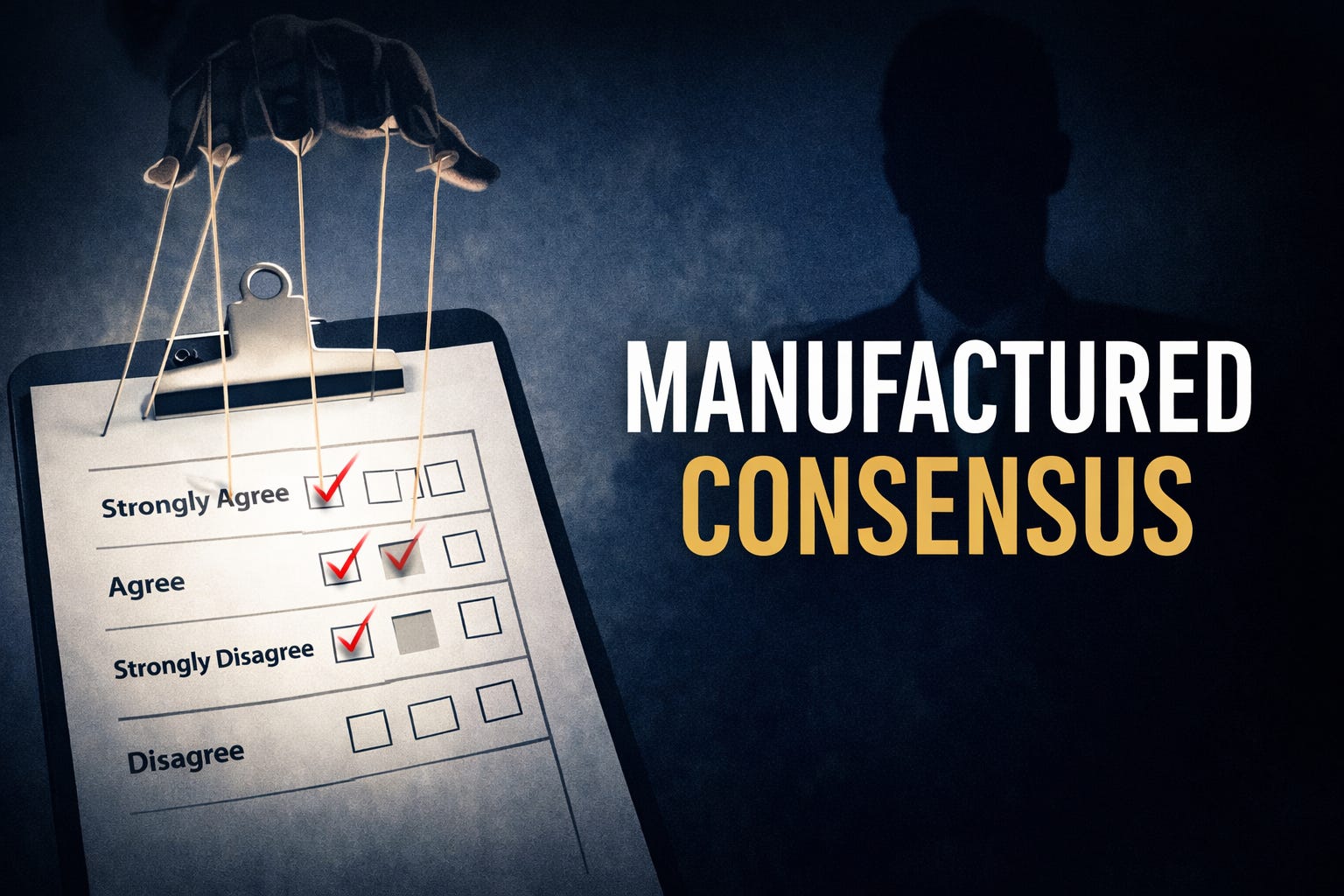
Corporate media echo-chambers and social media algorithms are typically blamed for driving deep and acrimonious division among the American people. But there is a small, often-overlooked industry that also amplifies this divide, while subtly disrupting the functioning of representative government: polling agencies with persistent conflicts of interest.
In politics, rigorously surveying the public on issues of the day is not only important—it is a critical independent tool for understanding beliefs, attitudes, and preferences, as well as changes in these factors over time. There are many polling agencies with various operating models; those that are private but independent (e.g. Zogby), some that are foundation-funded (e.g. Pew Research Center), and others that are largely non-partisan and employee-owned (e.g. Gallup).
Given the limitations of scope and methodology of public polls done routinely, many political operators, private businesses, and other institutions may decide to hire a polling agency to see what the public is thinking about a specific product, issue, or policy idea. These engagements are usually time-bound and temporary, and run in the tens of thousands of dollars to execute—the contracting agency or individual hires the polling agency to act as a vendor for a service, and then the two part ways. The information can either be kept private or used for marketing, strategy, or other purposes.
But there is another category of pollsters: conflicted private polling agencies that combine political polling with strategic services, that are as much an actor on the political stage as a surveyor. Many millions of dollars per year can be paid in a given year from a single political faction to this kind of pollster. In this scenario, the polling agencies may be asked or nudged to provide a specific outcome in a poll, and their dependence on a single customer (or group of politically affiliated customers) will predispose them to comply for fear of losing business if a purely accurate result were provided.
At the same time, many polling groups also receive far more in revenue for strategic services and marketing research from corporations and associations that would like to purchase some indirect influence over what kind of data is generated, and what advice the pollster offers to powerful political groups.
Once a poll has been commissioned in this kind of scenario, to generate a largely predetermined outcome, the polling agency will then simply use the tricks of the trade. The methods used to manipulate a poll result are extremely simple.
The way a question is phrased or asked, the order that survey questions are presented, the demographic breakdown of the target group, all can easily sway a poll in one direction or another. It is not difficult to ask respondents to rank issues of importance while carefully crafting the adjectives to make some options sound agreeable and others disagreeable.
This kind of manipulation is a serious issue when implemented at scale. Giving inaccurate information for conflicted reasons to a political client is not just bad business and poor methodology for a pollster; the polls are used to inform policy—and simultaneously manipulate the public. The result is a growing perception that government itself is the number one problem the country faces. The public simply sees that its priorities and opinion are not reflected in state capitols or Washington D.C. And for good reason, because polls are largely designed to justify policy, not accurately portray public sentiment.
The antidote to this dysfunction is a customer and polling agency that jointly agree that they are focused on direct policy questions, clearly stated, to a demographic breakdown that is honestly representative of the target audience. But this is seemingly the exception rather than the rule in political polling today.
Mis-attribution of Success, and Post-Election Danger
As counterintuitive as it may sound, the most dangerous in-house polling agency is one aligned with a successful candidate who has just won a race. In this scenario, the victory can be lazily attributed to the polling agency’s skills at gauging public opinion, when in fact it may have been independent of their services, or even in spite of their flawed data.
Additionally, at the point of success, that polling agency will have a rush of new interested clients outside of the political world, for obvious reasons. There is not only an aura of political acumen but also an avenue for influence over the new Governor, Senator, House member, or President. If a small polling agency suddenly has the ability to internally influence the new President of the United States, a few million dollars in “strategic consulting” work from an interested corporation or Political Action Committee is an easy way to indirectly influence policy direction. It so happens, there is a timely case study for this phenomenon.
Case Study: Fabrizio, Lee & Associates
In recent months, several notably slanted and manipulative polls have been circulating around the Trump administration and adjacent news organizations, claiming that the public has soured on any reforms on health freedom issues and that the White House should abandon these priorities. These polls were methodologically absurd and yet were amplified by officials and media figures alike.
These polls circulated internally at the White House, and from The Wall Street Journal to The New York Times there was a rare bipartisan consensus that was quite favorable to the pharmaceutical industry and dismissive of efforts to reduce corruption, improve safety, and respect individual medical freedom as “bad politics.”
[Note: to see a direct and independent polling effort on this topic, please see HFDF and Brownstone Institute’s Zogby Medical Freedom poll from February 2026.]
When one examines these polls and strangely coordinated media coverage, the name Fabrizio, Lee, & Associates appears frequently as a source for this survey data.
This is a private polling agency from Florida that lists its clients (to its credit) on its website proudly. In the policy arena of health freedom and clean water and soil, these are not inconsequential names:
American Medical Association (largely pharmaceutical company-funded)
Dow Chemical
Pfizer Pharmaceutical
Pharmaceutical Research & Mfg of America (PhRMA)
Philip Morris and Altria
R.J. Reynolds Tobacco Co.
Procter & Gamble
American Insurance Group (AIG)
Alongside these interests, listed as clients on the same page are Presidents (including the current administration), Senators, Congresspeople, Governors, the Republican National Committee, and Republican Governors’ Association among others. FEC data for the millions flowing to the company can be found here.
Any neutral observer would see this scenario and consider it a conflict of interest. Millions flow into the polling agency to provide strategic services from pharmaceutical companies and pharmaceutical-funded organizations seeking “strategic advice.” Millions also flow in from politicians seeking reelection and campaign financing (often procured from those same companies).
This polling agency is then tasked with surveying and assessing public opinion on issues of medical freedom and industry/federal reforms. In this case, they provided an answer that pleased the pro-industry actors inside the White House and the pharmaceutical companies themselves, who are also clients. This is not surprising. What is surprising, however, is that any serious political observer would consider this polling reliable.
This firm serves as an obvious example of the conflicted in-house polling agency that acts as a pass-through for influence for private business while providing slanted polling and strategic advice. At its worst, this is a form of regulatory capture through an intermediary.
Where the interests diverge between clients from the worlds of business and politics, this advice could serve the industry client base to the potential detriment of its political patron, or more rarely, the opposite. In most circumstances an effort would be made to please as many customers as possible simultaneously, a quite unrelated task to conducting a basic and direct poll of opinions on medicine, health, and individual rights.
When their interests already overlap (as is the case when those in the White House directing the polling have also worked for those same companies’ interests professionally), the polling and political advice will be in favor of those business interests overwhelmingly, with the public’s true opinions being of little concern. This is the closest description of the current situation on this issue.
Perhaps even more pernicious is the potential for these contrived polls to be deployed to justify policies diametrically opposed to the interests of the public. These polls essentially provide cover to politicians to ram through policies that serve corporate interest under the pretense of popular support.
Of course, this dynamic is particularly severe when the President is not eligible for another term, and failure in a follow-up national contest is not even possible. Electoral considerations are now far removed.
It is worth noting that when a Presidential election was in the foreground, Fabrizio’s team correctly indicated the critical importance of Robert F Kennedy Jr.’s voters to Trump’s ultimate success in 2024. Now, the agency has seemed to have forgotten this reality with the midterms looming, as it predictably serves its own interests. If history is a guide it is very likely that Fabrizio will compound this cynical betrayal of their political customers in the White House, by blaming a disaster in the midterms on the very issue that could have brought them success—that of medical freedom.
Originally posted on HealthFreedomDefense.org.
These creeps need a crash course in ethics. They also need a course in the Constitution. I consider them traitors to American and its people and traitors to the human race.
There’s all zero reason to believe people who were in favor of better health outcomes would have soured on it so suddenly.